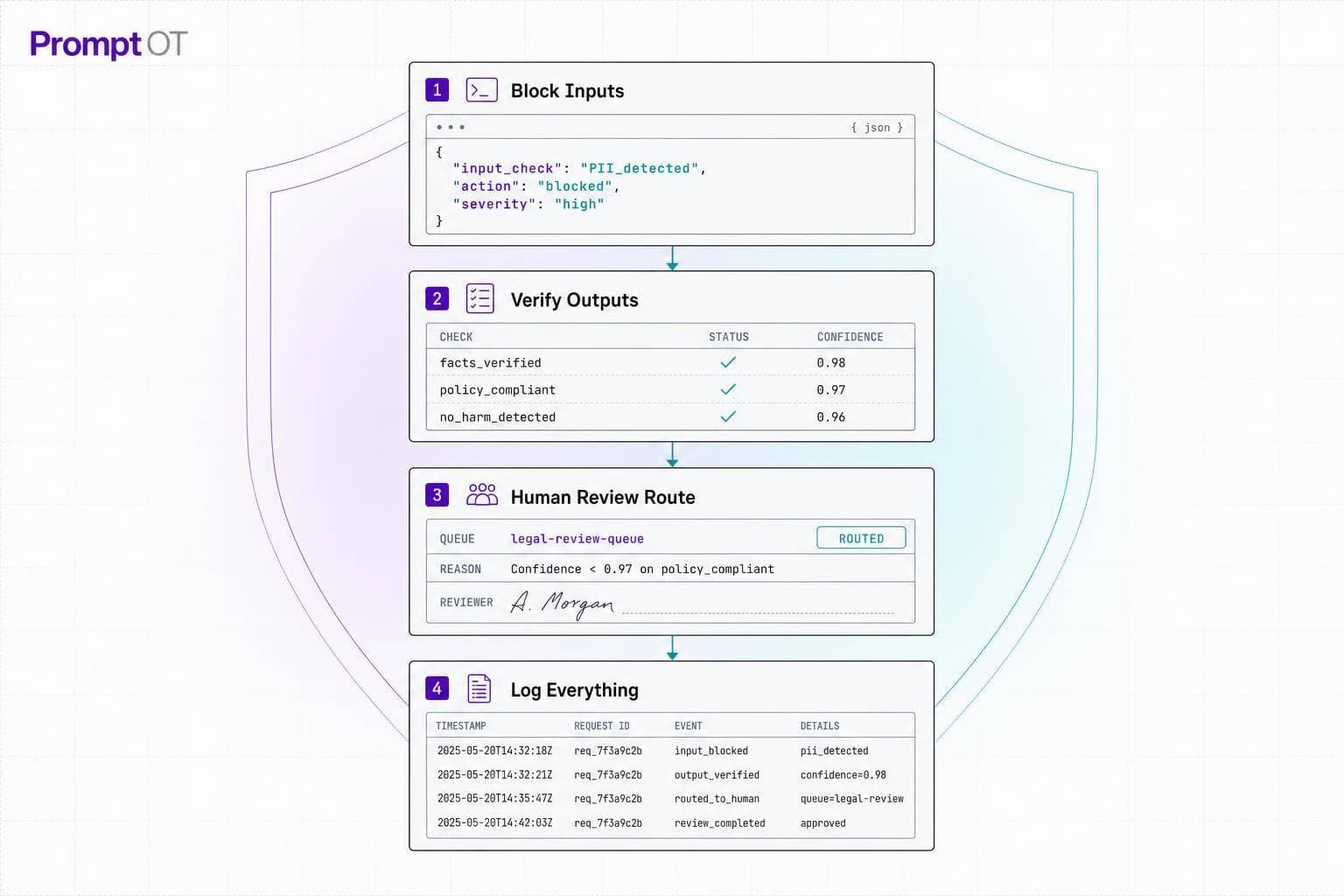
If you can’t trace an AI output back to its prompt, data, sources, model version, and human reviewer, your guardrails are not enough.
I’d sum up the article this way: legal AI guardrails work when they do four things at runtime, not just on paper:
- block sensitive inputs before they reach the model
- check outputs for false claims, toxic text, and data leaks
- route high-risk work to human review
- keep logs that an auditor, court, or regulator can follow
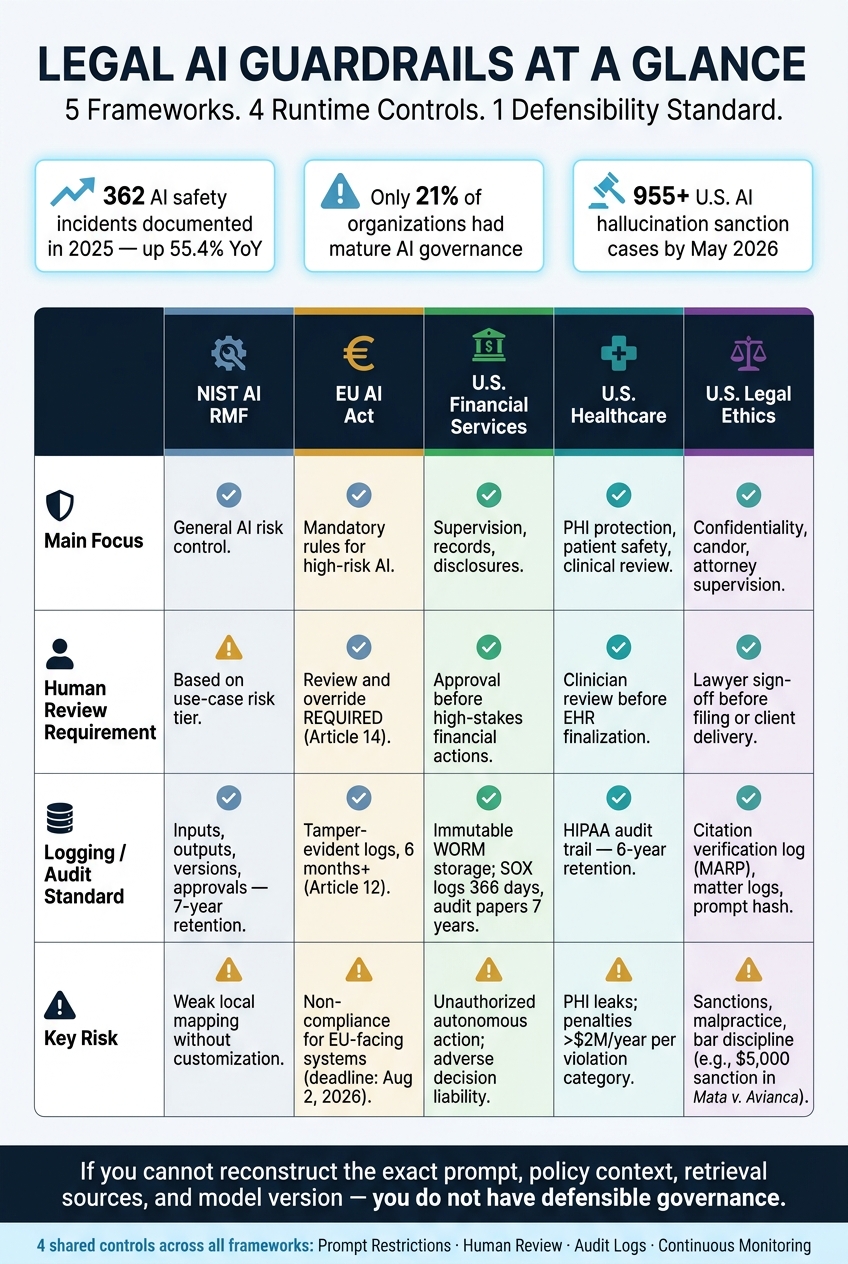
The article compares five rule sets that push those controls in different ways:
- NIST AI RMF: a U.S. starting point for AI risk controls
- EU AI Act: stricter rules for high-risk AI, including logging and human override
- U.S. financial services: heavier focus on supervision, records, and approval flows
- U.S. healthcare: tighter PHI controls, clinician review, and 6-year HIPAA logs
- U.S. legal services ethics: privilege protection, citation checks, and lawyer sign-off
A few numbers show why this matters: 362 AI safety incidents were documented in 2025, up 55.4% year over year, and only 21% of organizations had mature AI governance. In legal work alone, more than 955 U.S. AI hallucination sanction cases had been identified by May 2026.
Legal AI Guardrails: 5 Framework Comparison Guide
The Safety and Compliance Guide for Law Firms using AI
sbb-itb-b6d32c9
Quick Comparison
| Framework | Main Focus | Human Review | Logging Focus | Main Risk |
|---|---|---|---|---|
| NIST AI RMF | General AI risk control | Based on use case tier | Inputs, outputs, versions, approvals | Weak local mapping |
| EU AI Act | Mandatory rules for high-risk AI | Review and override required | Tamper-evident logs, 6 months+ | Non-compliance for EU-facing systems |
| U.S. Financial Services | Supervision, records, disclosures | Approval before high-stakes actions | Immutable records, WORM-style storage | Bad decisions affecting money or access |
| U.S. Healthcare | PHI, patient safety, clinical review | Clinician review before final use | HIPAA audit trail, 6 years | PHI leaks and unsafe clinical output |
| U.S. Legal Ethics | Confidentiality, candor, supervision | Lawyer review before filing/client use | Citation checks, matter logs, sign-off | Sanctions, malpractice, bar issues |
Bottom line: I’d treat prompts like controlled business records. Version them, approve changes, limit data access outside the model, and log every high-risk step.
1. NIST AI Risk Management Framework (AI RMF)
NIST is the baseline framework because it turns abstract AI risk into day-to-day controls. The AI RMF is voluntary, but in practice it now works like a baseline. Procurement rules, safe-harbor provisions, and insurers increasingly treat it that way. The Colorado AI Act gives NIST AI RMF compliance a rebuttable presumption of "reasonable care", and Colorado's safe harbor for legal services starts June 30, 2026. Federal procurement rules now require NIST alignment for many contracts. Malpractice and cyber insurers also look at NIST alignment during underwriting at renewal.
Those controls sit under four functions: Govern, Map, Measure, and Manage.
Prompt Controls
Measure and Manage drive the technical controls. At the input level, that means prompt injection detection, PII redaction, and jailbreak filters to keep privileged data, PHI, and CUI from reaching the model. At the output level, it means grounding checks - verifying outputs against source documents to catch hallucinations.
A February 2026 red-team study from Harvard, MIT, Stanford, and Carnegie Mellon found that AI agents exfiltrated data and triggered unauthorized operations in live enterprise environments despite model-level safety filters. That points to a plain problem: safety filters alone don't do the job. Access controls must be enforced at the data layer, separate from the model, to block unauthorized access to regulated data like PHI or CUI.
Human Oversight
Risk tiering keeps oversight workable. High-risk use cases - like AI drafting client-facing briefs or processing privileged strategy documents - need mandatory human verification and partner sign-off. Low-risk tasks, such as administrative scheduling, need only basic data-handling awareness.
In practice, that means setting clear review gates:
- pre-use approval of tools and data sources
- in-process spot checks
- pre-delivery validation of any AI-generated work product before it reaches a client
Auditability
Measure supports system inventory, risk tracking, and incident logging. The aim is defensibility: proving what the model saw, what it returned, and who approved it. That means keeping a live approved-tools list and logging each AI interaction: prompt, output, model version, user ID, matter ID, and source citations. Retain records for seven years.
Audit committees now want incident logs, approved tools, and training evidence. PromptOT supports this with versioned guardrail blocks and audit logs.
The EU AI Act takes this baseline and makes parts of it mandatory.
2. EU AI Act
Unlike NIST’s voluntary baseline, the EU AI Act makes some guardrails mandatory. It follows a risk-based structure with four tiers: Prohibited, High-Risk, Limited Risk, and Minimal Risk.
For legal and regulated workflows, High-Risk is the tier that matters most. It covers AI used in areas like recruitment, credit scoring, and legal and court-use cases. And if your system serves EU users, the Act may apply even if your company is based outside the EU.
Regulatory Scope
For Annex III high-risk systems, the current deadline is still Aug. 2, 2026 unless the proposed delay is formally published in the EU Official Journal.
Prompt Controls
Under Article 15, high-risk systems must hold up against adversarial inputs. In plain English, you can’t just hope the model behaves well when someone tries to confuse it or push it off track.
Article 10 also requires data governance controls. That means protected attributes like race and gender need to be masked before they reach the model or show up in logs. Prompt instructions by themselves are not enough for compliance. The controls have to sit outside the model, with runtime policy checks on both inputs and outputs.
Human Oversight
Article 14 says high-risk systems must be built so humans can review and override them. That sounds basic, but many companies still aren’t there. Only 37% of enterprises currently have an emergency stop capability for their AI agents, despite the oversight expected under the Act.
Regulators are also pushing for human review queues. In those setups, a person must interact with or modify an output before final approval. The goal is to reduce automation bias, which is what happens when people trust machine output too quickly just because it came from a system.
Auditability
Article 12 requires automatic, tamper-evident logs of inputs, outputs, and decisions. Deployers of high-risk systems must keep those logs for at least 6 months.
This is where things get more concrete. Regulators are moving away from paperwork-only compliance and toward real-time, searchable audit logs.
U.S. sector rules add further controls on top of this baseline.
3. U.S. Financial Services Guardrails
U.S. financial regulators treat AI like any other operating tool. That means the usual rules still apply: supervision, recordkeeping, and risk controls. In practice, finance uses guardrails similar to NIST and the EU, but with heavier oversight, disclosure duties, and longer record retention.
Regulatory Scope
The Treasury's February 2026 FS AI RMF adds 230 control objectives for financial firms and translates NIST into finance-specific controls. That gives firms a more direct playbook instead of leaving them to map broad AI risk ideas on their own.
For banking, the main frame comes from Federal Reserve SR 11-7 and OCC 2011-12. Those rules call for lifecycle governance, independent validation, and ongoing monitoring for models, including LLM-based decision tools. Put simply, if an AI system helps make decisions, it can't just be turned on and left alone.
Securities firms need to pay close attention to FINRA Rule 2210 on fair communications, along with SEC fiduciary duty and disclosure expectations. That matters most when firms talk about AI in marketing, client communications, or product materials. A small wording slip can turn into an unsupported AI claim.
Consumer finance brings added risk. Credit scoring and similar use cases face pressure under UDAAP and ECOA, where firms need to explain adverse actions and watch for bias. If a model helps deny credit, the firm still has to explain what happened in a way regulators can follow.
Prompt Controls
In financial services, the prompt isn't just a line of text. It's a governed artifact. It should be versioned, tested, and checked before release.
Treat prompts like controlled policy artifacts. Run regression tests before updates go live, and use lexicon checks to block unsupported performance claims. That may sound strict, but in finance, language carries legal weight. One loose phrase can create disclosure trouble or fair-marketing risk.
FINRA says it directly: "Testing of algorithmic strategies prior to being put into production is an essential component of effective policies and procedures".
For Tier 1 systems that affect credit decisions, real-time monitoring and quarterly reviews fit the risk level. That's the right mindset here: if the output can affect a person's money, access, or rights, prompt changes need the same care as model changes.
Human Oversight
Recent SEC and FINRA actions show what happens when approvals get skipped. So for high-stakes AI, the safer setup is read-only use until a human approves any trade, account change, or adverse-action decision.
Regulators also expect people to be able to override automated decisions in lending or fraud disputes. That override can't be fake. It has to work in practice, not just sit in a policy binder.
FINRA's 2026 report also points to a risk that stands out for agentic systems: unauthorized autonomous action. That's a big deal in finance. If a system acts on its own in the wrong context, the damage can move fast.
Auditability
Firms must keep immutable logs of prompts, context, and decision rationale. SEC Rule 204-2 and FINRA Rule 17a-4 require firms to preserve records whether the content came from a person or a model.
Regulators expect tamper-evident records, such as WORM storage or hash-chained event ledgers. The record should include:
- prompt
- context
- model version
- user ID
- matter or account ID
- source citations
- approval record
All of that should sit in tamper-evident storage.
For SOX-relevant systems, operational logs should be kept for at least 366 days, and audit work papers for 7 years. The same pattern shows up in healthcare too, where PHI and clinical workflows bring tighter data-handling rules.
4. U.S. Healthcare Guardrails
Healthcare AI sits where patient safety, privacy law, and clinical accountability all collide. That makes it one of the most tightly regulated settings for LLM deployment.
Regulatory Scope
Healthcare AI falls under several regulators at once: the FDA for SaMD, HHS OCR for HIPAA, and the FTC for deceptive AI claims. The FDA's Predetermined Change Control Plan (PCCP) lets teams make some model updates without a full resubmission, as long as the safety guardrails are documented.
The 2025 HIPAA Security Rule amendments also changed the bar. Encryption is now mandatory for AI data flows. Civil penalties carry annual caps of more than $2 million per violation category, and state-level penalties can top $250,000 per violation.
States aren't waiting around either. About 38 states have passed AI-related legislation, and nearly 400 AI-related bills were pending as of mid-2026. Texas (TRAIGA) and California (AB 3030) both require clear disclosure to patients when AI is used in their care.
Put simply, healthcare guardrails are stricter than general-purpose AI rules because privacy, safety, and marketing law all apply at the same time.
Prompt Controls
System prompts are not enough for HIPAA access controls. Telling an LLM to avoid certain PHI categories does not count as a technical safeguard under the Security Rule, because prompt injection can get around it. The control has to happen at the data layer.
A safer setup looks like this:
- Use PHI redaction or tokenization before data reaches the model, then re-identify it only in the presentation layer for authorized users.
- Use pre-LLM classifiers to block diagnostic or dosage prompts and send them to safe responses or human review.
"The Association of American Medical Colleges insists on 'multiple, redundant guardrails' and requires at least 95% accuracy in blocking diagnostic claims without physician oversight." - Vicki Powell, Rioworld
In healthcare, a prompt isn't just an instruction string. It's a protected workflow entry point.
Human Oversight
AI-generated clinical content needs review by a qualified clinician before anything is finalized in an EHR. In several jurisdictions, unsupervised AI-generated records may be treated as unauthorized practice of medicine.
That means escalation can't be left to chance. Teams should set triggers that automatically route cases to a clinician when groundedness drops below a defined threshold or when a query enters high-risk clinical territory.
Break-glass protocols should allow immediate access during emergencies, but with stronger logging, not less accountability. Every AI interaction must tie back to one authenticated person. Dual attribution logging should record both the AI system and the human user.
Auditability
HIPAA requires audit logs for PHI access to be kept for at least 6 years. Those logs also need to be tamper-evident. Teams can do that with cryptographic hashes, HMAC chains, or WORM storage.
A defensible audit trail should capture:
- Timestamp
- Decision ID
- User identity
- Model version
- Inputs
- Prompt and policy version used
- Output
- Review rationale
- Overrides
For teams managing prompt versions across clinical workflows, PromptOT's versioned prompts and HMAC-signed webhooks support integrity and traceability.
The same pattern - tight supervision, traceability, and role-based review - extends into legal-services ethics.
5. U.S. Legal Services Ethics Guardrails
Legal AI is its own kind of risk. Lawyers are officers of the court, so when AI fails in legal work, the fallout can be severe: bar discipline, malpractice claims, and sanctions from federal judges. As of May 2026, more than 955 AI hallucination sanction cases had been identified in the United States.
Regulatory Scope
Legal AI use is shaped by a patchwork of ABA Model Rules, state bar opinions, and court standing orders. ABA Formal Opinion 512 links generative AI use to duties of competence, confidentiality, candor, and supervision. In plain terms, competence now means having a reasonable grasp of what a given tool can and cannot do. As of April 2026, 42 state bars had issued opinions on AI use, and more than 300 federal judges had issued standing orders that require AI disclosure or certification in filings.
The rules also split by state in ways that matter. Florida requires AI chatbots to include disclaimers that identify them as non-human. Texas says that if AI saves time in an hourly billing setup, that gain must be passed on to the client. Virginia looks at the value of the work product, not just the time saved. The ABA gives firms a floor, but multi-state practice still means tracking state-by-state rules.
Unlike healthcare or financial services, legal AI mistakes can trigger personal professional discipline, not only agency action.
In practice, the central issue is simple: can the firm defend what went into the prompt, what came out, and what records it kept? That plays out in three places: what enters the system, who checks the output, and what gets logged.
Prompt Controls
The first danger zone is confidentiality. Client data should move only through screened, approved workflows. It should not go into tools that retain prompts or train on them without informed consent. If someone drops privileged drafts, PII, or case-specific facts into a consumer-tier tool, the firm may create privilege-waiver risk under the third-party disclosure doctrine. Firms also need matter-level access barriers so one client’s information doesn’t spill into another client’s work.
A tiered data policy deals with that risk head-on:
- Prohibited inputs, such as PII, M&A documents, and privileged drafts, never go into public models.
- Approved tasks, such as legal research or contract review, go through enterprise tools with mandatory human verification.
- Other approved work can move forward with lighter review.
It also helps to use a fixed prompt template that locks in governing law, jurisdiction, and citation rules. The RCTFC framework - Role, Context, Task, Format, Constraints - can cut down on hallucinations and wrong-jurisdiction output. Constraints should state the governing law directly, such as "Apply only New York law", and tell the AI to say so when a source cannot be verified.
Human Oversight
Every citation needs to be checked by a human against a primary source such as Westlaw or Lexis before anything is filed or sent to a client. No AI draft should leave the system without human legal review.
The risk here isn’t abstract. In Mata v. Avianca, Inc. (S.D.N.Y., June 2023), attorney Steven Schwartz was sanctioned $5,000 for filing a brief that cited six fake cases generated by ChatGPT.
"Technological advances are commonplace and there is nothing inherently improper about using a reliable artificial intelligence tool for assistance... But existing rules impose a gatekeeping role on attorneys to ensure the accuracy of their filings." - Judge P. Kevin Castel, U.S. District Court for the Southern District of New York
Supervisory lawyers also have their own duty. They must make reasonable efforts to ensure that both lawyers and nonlawyers at the firm meet their professional obligations.
Auditability
In legal work, proof matters. That means logging has to show citation checks, reviewer approval, and the final filing state. Basic system logs aren’t enough. Legal AI needs citation-level audit trails. Firms should use a Mandatory AI Review Protocol (MARP): citation validation through Shepard's or KeyCite, factual grounding against source exhibits, and draft labeling as "AI-Assisted" until a human signs off.
Each log entry should record the UTC timestamp, user ID, matter ID, model version, prompt hash, and the name of the human reviewer. Those records are there to show compliance to courts, bars, and opposing counsel, not just to satisfy internal policy.
The table below maps each core duty to its guardrail requirement and the audit mechanism behind it:
| Duty | Guardrail Requirement | Auditability Mechanism |
|---|---|---|
| Confidentiality | Enterprise-tier tools only; no-training commitment | Vendor DPA review log |
| Competence | Mandatory AI training for all staff | Training completion records |
| Candor | Independent verification of all citations | Citation verification log (MARP) |
| Supervision | Human-in-the-loop for all deliverables | Supervisory sign-off on AI drafts |
| Fees | Bill only for actual human review time | Transparent billing narratives |
Pros, Cons, and Tradeoffs by Framework
Every framework makes a tradeoff between flexibility and enforcement. Some give you room to interpret. Others tell you, in plain terms, what must happen. The table below shows which one is easiest to put in place, which one is hardest to defend, and which one lines up most closely with prompt-level controls.
| Framework | Breadth | Flexibility | Documentation Burden | High-Stakes Fit | Prompt-Guardrail Fit |
|---|---|---|---|---|---|
| NIST AI RMF | Broad, low-specificity guidance | Flexible and voluntary | Moderate | Moderate - requires custom mapping | Moderate; needs custom mapping |
| EU AI Act | Broad, high-specificity guidance | Highly prescriptive (mandatory) | Highest | Excellent | High; human oversight requirements map well to versioned prompt workflows |
| U.S. Financial Services | Sector-specific / High data specificity | Moderate flexibility / High prescriptiveness on access | High | High - especially for irreversible financial actions | High; strict access controls can be enforced with {{user_role}} variables |
| U.S. Healthcare | Sector-specific / High PHI specificity | Moderate flexibility / High prescriptiveness on access | High | High - safety-critical PHI environments | High; data-layer controls and {{jurisdiction}} variables help prevent jurisdictional drift |
| U.S. Legal Ethics | Sector-specific / High process specificity | Moderate flexibility / Moderate prescriptiveness | High | High - citation verification and attorney sign-off matter | Excellent; versioning and {{jurisdiction}} support traceability across matters |
The main pattern is pretty clear: the more regulated the workflow, the less you can rely on policy documents alone. Guardrails have to move out of static policy text and into runtime controls that the system can actually enforce.
NIST AI RMF is the easiest place to start, but it can be the hardest to turn into day-to-day controls without local mapping. The EU AI Act is the strictest of the group, but it also gives the clearest path for operations. The U.S. sector rules are narrower, yet they come down harder on data access.
That’s the core tradeoff. Model filters control output. Data-layer controls control access. Those are not the same thing, and mixing them up can leave gaps.
Legal ethics is the least forgiving. Citation verification and attorney sign-off are mandatory. Prompts should be treated as controlled operational artifacts - versioned and traceable enough to show why a specific output was generated.
That shift gets easier when teams use versioned prompt blocks. Versioned prompts, paired with runtime variables, make it much easier to enforce policy across roles and jurisdictions.
Conclusion
Taken together, this comparison points to one simple rule: runtime controls matter more than policy alone. Across the five frameworks, the shared controls are prompt restrictions, human review, audit logs, and monitoring. Where they split is in how strict those controls need to be. Legal work calls for citation checks and attorney sign-off. Healthcare calls for PHI redaction and careful clinical language. Financial services puts more weight on suitability controls and recordkeeping. The EU AI Act makes these controls mandatory for high-risk systems, while NIST remains a flexible U.S. starting point.
If you cannot reconstruct the exact prompt, policy context, retrieval sources, and model version behind a regulated output, you do not have defensible governance.
For U.S. organizations, the takeaway is pretty direct: treat prompts as governed artifacts. In practice, that means versioning them, requiring approvals before changes go live, and keeping a change history an auditor can follow. Structured prompt management gives teams a way to version guardrails, control access, and maintain a clean audit trail across draft, review, and production. PromptOT supports that workflow with version control, role-based access, and environment-scoped API keys, so regulated prompts can move from draft to production with traceable changes at each step. As rules change, prompts need to change with them, and the audit trail should move right alongside.
FAQs
What makes an AI workflow high risk?
An AI workflow becomes high risk when it touches legal advice, court filings, privileged strategy, or client-facing work that goes out without human review. The risk also goes up fast when the workflow handles sensitive or confidential data.
Why? Because these setups can leak privileged information, introduce bias, or hallucinate citations and legal authorities. That’s the part that can trip teams up.
PromptOT helps lower that risk by treating guardrails as first-class prompt components and by supporting consistent, versioned prompt blocks.
Why aren’t model safety filters enough?
Model safety filters aren't enough because they mostly catch obvious, predefined harms like toxicity or explicit language. But many risks don't look obvious at all.
They often miss context-specific or legal issues, such as misleading advice, biased decisions, or fabricated citations.
There's another problem: these filters are usually probabilistic, not deterministic. That means they can behave inconsistently, which is a bad fit for high-stakes use cases.
PromptOT helps teams add layered, context-aware guardrails that enforce specific organizational policies.
How should teams audit AI outputs?
In regulated settings, teams should shift from after-the-fact review to real-time inference control. A retroactive audit may not satisfy legal evidentiary standards.
Audit-ready validation starts with provenance metadata. That includes prompt versions, model settings, and tool calls. Teams also need to tie that data to an immutable log that shows why an output was approved at the moment it was produced.
With PromptOT, teams can version guardrail blocks and keep validation logic consistent and traceable.