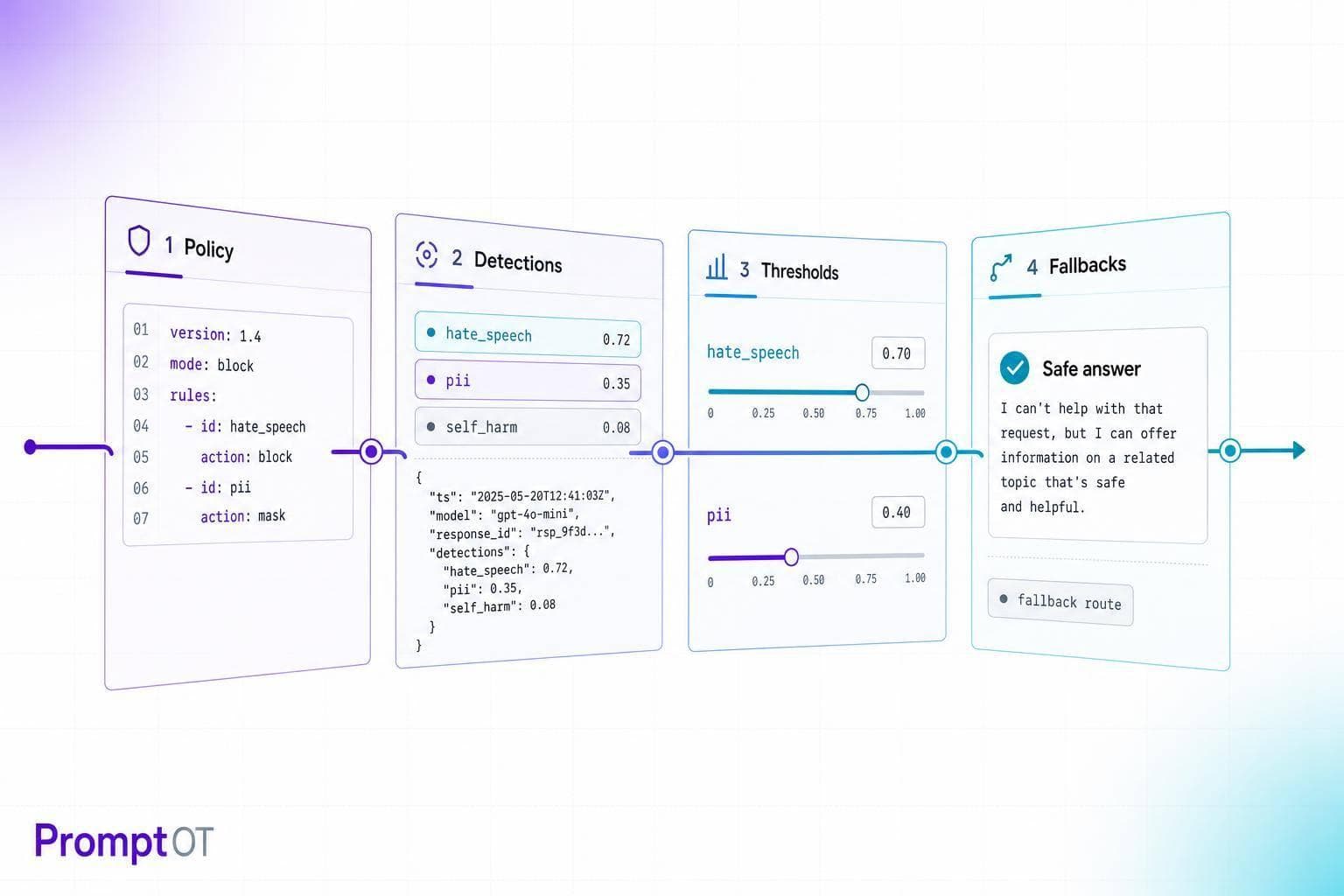
If you ship LLMs, output moderation needs its own control layer. The core idea is simple: check every model reply before it reaches the user, then allow, block, rewrite, redact, or send it for human review based on clear rules.
Here’s the short version:
- I’d treat policy as the starting point, not prompt tweaks
- I’d separate detection, policy, and enforcement
- I’d use a layered pipeline:
- deterministic checks
- ML classifiers
- LLM review for gray areas
- human review for high-risk cases
- I’d focus on key U.S. risks:
- harmful content
- self-harm content
- PII/PHI leaks
- confidential data leaks
- made-up legal, medical, or financial advice
- tone and brand issues
- I’d set category-specific thresholds, not one cutoff for everything
- I’d plan for timeouts, outages, retries, and safe fallback messages
- I’d track precision, recall, false positives, false negatives, and drift
- I’d make red-team tests and human feedback part of release checks
A few numbers from the piece show why this matters: one example uses a 0.5 policy threshold against a 0.7 self-harm score to trigger a safer rewrite, Tier 1 checks can run in under 10 ms, and many chat systems aim for a 500–800 ms P95 total latency budget, moderation included.
The big takeaway: output guardrails work best when they’re treated like a production system with rules, logs, fallback paths, and change control, not just a prompt add-on.
That’s the frame I’d use for the rest of the article: keep the policy clear, keep the pipeline layered, and keep every change testable and traceable.
Building Safer AI: Implementing Guardrails for LLM Applications by Roberto Carratala
sbb-itb-b6d32c9
Define Your Moderation Policy Before Writing Guardrail Logic
Before you write a single line of guardrail code, write the moderation policy first. That policy should spell out what gets allowed, blocked, redacted, rewritten, or escalated. Start there because guardrail logic only works when the expected outputs are already clear.
Map Categories, Scores, and Actions to Clear Enforcement Rules
Define only the categories your product will actually enforce. Each one needs a plain-English definition plus examples, so automated classifiers and human reviewers can make the same call when a case lands in the gray area.
Severity levels help you avoid treating every issue the same way. A low-risk case shouldn't trigger an expensive response. Once severity is set, thresholds turn scores into actions. Use category-specific thresholds to map scores to actions. Don't use one universal cutoff for every kind of risk.
A Twitch moderation audit found that automated systems flagged only 22% of hateful content at their most stringent setting, and that 89.8% of false negatives contained no profanity at all - which suggests a policy built around slurs and keywords will miss a lot of implicit harm. That’s why category-specific thresholds matter. They make enforcement more precise than a one-size-fits-all cutoff.
These rules then feed into the moderation pipeline covered in the next section.
Handle Context, Bias, and Auditability
Context changes what "safe" means. A clinical decision-support tool for licensed physicians can show detailed medication information that would be out of bounds in a general consumer chatbot. A news research assistant may need to return descriptions of violent events that would be blocked in a customer service flow. Allowlists and denylists should be based on context and intent, not just keywords.
Bias is also an operational risk. Moderation classifiers can flag content about some identity groups more aggressively than content with the same meaning about other groups. That can create disparate impact across U.S. protected classes. Audit outputs across demographic groups and topic slices before launch, then track drift over time.
Every policy change should have:
- a version number
- an effective date
- an owner
- a rationale
You should also keep a replay test set: a fixed set of past inputs and expected outcomes that you can run against any new policy draft before it goes live. Log every policy change with version, owner, timestamp, and rationale.
Use PromptOT to Version Guardrail Prompts and Policy Text
Policy text tends to drift when prompts and rules live in separate systems. PromptOT fixes that by storing policy language in dedicated guardrail blocks - a first-class block type that sits alongside role, context, and instruction blocks in the same prompt composition.
Every change is saved as an immutable versioned artifact with author, timestamp, and a visual diff against the prior version. If a new policy draft causes unexpected over-blocking in production, one-click rollback restores the previous published version right away through the API. Environment-scoped API keys add a safety layer: development keys fetch the latest draft, while production keys only serve the published version. That means stricter rules can be tested in a sandbox before they touch live users.
Placeholders let one guardrail block work across multiple environments. A block can include {{policy_version}} and {{region}}, with values resolved at fetch time based on the calling app's context. A healthcare flow can pull a stricter policy variant, while a general consumer flow gets a different enforcement profile, all from the same versioned block.
Once the policy is versioned, it can be delivered the same way across environments and enforced in the pipeline. With policy defined, the next step is to separate detection, policy, and enforcement into a layered moderation pipeline.
Build a Layered Output Moderation Pipeline
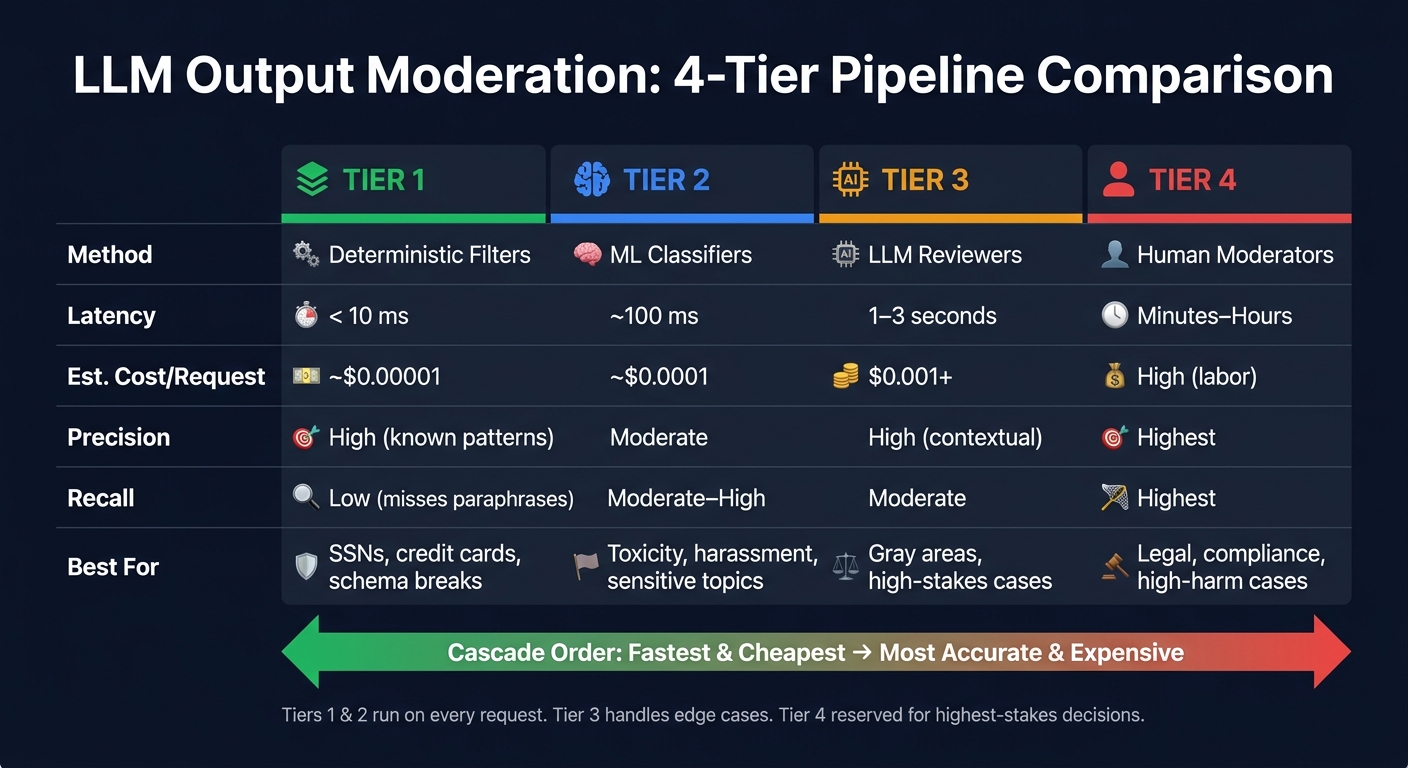
LLM Output Moderation Pipeline: 4-Tier Comparison Guide
One moderation step isn't enough in production. A blocklist, a classifier, or an LLM judge can each miss issues that another method would catch. The safer setup is defense in depth: several gates in sequence, with each one handling a different kind of risk, so one weak spot doesn't turn into a system-wide problem. In practice, these tiers turn policy rules into a routing system. Each risk category gets the lightest gate that can handle it with enough safety.
Use Deterministic, ML, LLM, and Human Review Tiers Together
Tier 1 handles deterministic checks: regex patterns, blocklists, PII formats like SSNs and credit card numbers, and schema validation. This tier is best for stopping plain, easy-to-spot issues early, such as SSNs, credit cards, and schema breaks.
Tier 2 adds lightweight ML classifiers for more nuanced labels, like toxicity severity, sensitive-topic detection, and harassment signals. These models can catch paraphrased or indirect violations that rules miss. But they need threshold tuning by category. One global threshold usually falls apart here. Use this tier for labels like toxicity, harassment, and sensitive topics.
Tier 3 sends uncertain or high-impact cases to an LLM reviewer. LLM review can cut false positives, but it still misses too many violations to be the only gate. Use it only when the case is unclear or the stakes are high enough to need more context.
Tier 4 is human review. This is the right place for legal, compliance, or high-harm cases. Its decisions should also feed back into training and policy updates.
Separate Classification, Policy, and Enforcement in Your App
Keep classification, policy, and enforcement separate.
- Classification turns raw signals into labels and confidence scores.
- Policy maps those labels to actions.
- Enforcement applies the action before any user-visible output or tool call.
That split matters. If only part of a response is sensitive, redaction may be enough. If the full response isn't allowed, a safe fallback message makes more sense. And if the output is too risky to show at all, suppression is the safer move.
Moderation tends to work best as a cascade, with clear latency budgets, cost tradeoffs, and an appeals path for high-stakes cases.
Moderation Tiers Compared: Latency, Cost, and Accuracy
Use this table to match each tier to the right risk profile and traffic volume. For most startup and mid-market SaaS teams, Tiers 1 and 2 run on every request, Tier 3 handles a smaller share of traffic, and Tier 4 is saved for the highest-stakes decisions.
| Tier | Method | Latency | Est. Cost/Request (USD) | Precision | Recall |
|---|---|---|---|---|---|
| 1 | Deterministic filters | < 10 ms | ~$0.00001 | High (known patterns) | Low (misses paraphrases) |
| 2 | ML classifiers | ~100 ms | ~$0.0001 | Moderate | Moderate–High |
| 3 | LLM reviewers | 1–3 seconds | $0.001+ | High (contextual) | Moderate |
| 4 | Human moderators | Minutes–Hours | High (labor) | Highest | Highest |
Each tier should output the same normalized label and confidence format so enforcement can act without depending on how the issue was detected. That separation keeps the system usable in practice. Once every tier produces the same label and score format, the policy layer can route to the right action without the enforcement layer needing to know which tier made the call. That's what makes the system easier to explain, test, and maintain as policies change.
Implement the Pipeline with Guardrail Frameworks, Safety Services, and Observability
Once your tiers are set, the next job is making them run on every request without blowing past latency limits or turning the whole system into one fragile dependency. You want a fast lane for obvious cases and a slower lane for gray areas. To get there, make each tier run through a fixed validator chain, clear fallback rules, and shared event logging.
Chain Validators for Toxicity, PII, Structure, and Policy Violations
Run validators from the lowest-cost check to the highest-cost one: schema, PII, toxicity, then LLM review.
Start with schema checks. Make sure the response isn't empty, stays within size limits, and matches the format you expect. JSON Schema or Pydantic are a good fit here. Then run regex-based PII detection for U.S. patterns, including SSNs in the XXX-XX-XXXX format, credit card numbers, phone numbers, and email addresses. After that, pass the content through a toxicity or safety classifier. Only send ambiguous or high-stakes cases to an LLM policy check.
Every validator should return the same response shape so routing logic doesn't get messy. Use the same category names and severity levels from the policy section to keep enforcement lined up.
When output fails a check, either rewrite it or block it. A constrained rewrite can redact or neutralize the problem while keeping the same structure. Auto-retry calls the LLM again with updated instructions that clearly point out the violation. Keep retries to one attempt for soft failures. Hard violations - explicit illegal content, for example - should trigger an immediate block with no retry path.
Plan for Timeouts, Outages, and Safe Fallbacks
External safety services will be slow sometimes. At other times, they'll be down. Your pipeline needs clear rules for what happens next. Timeout behavior should follow the same allow/block/redact/rewrite rules defined earlier.
For latency-sensitive chat, aim for a 500–800 ms P95 end-to-end budget, moderation included. Give each external safety service a per-call timeout of 100–200 ms. If it doesn't answer in time, move on and apply the fallback rule.
For high-risk workflows like healthcare advice, financial transactions, or content publishing, that means blocking by default and returning a safe canned response instead of letting unchecked output slip through. For lower-risk chat, falling back to deterministic checks only is a reasonable middle ground, as long as you log that the system is running in reduced-safety mode.
Circuit breakers matter here. If a safety service fails again and again, mark it unhealthy and stop calling it until it recovers. Pair that with bounded exponential backoff and jitter on retries to avoid thundering-herd problems during incidents. Test these fallback paths on purpose with simulated provider failures. Don't wait for a live outage to learn that your safe fallback message is pointed at the wrong template. These rules only hold up if policy changes and failures show up clearly in logs.
Use PromptOT for API Delivery, Collaboration, and Moderation Event Hooks
If your team manages policy text outside app code, put delivery and change tracking in one place. Use PromptOT to deliver guardrail blocks, policy text, and environment-specific settings through one API.
Engineers can wire up the validators while policy owners edit guardrail text directly in PromptOT. Draft states let teams test changes in development before pushing them to production. If a new safety rule causes a spike in false positives, instant rollback takes you back to the last known-good version without a code deployment. Role-based access control helps keep editing rights in the right hands.
For observability, PromptOT's webhook notifications fire on moderation-related events, like when a guardrail block is published or when a policy block changes. They send HMAC-SHA256 signed payloads that your logging or incident system can verify before taking action on them. Route those events into logs or alerts so you can tie policy spikes back to exact changes. When the payload includes prompt IDs, environment scope, such as development vs. production, and version numbers, you can see exactly which change introduced a new class of moderation issues.
Measure, Scale, and Govern Output Guardrails Over Time
Track Precision, Recall, False Positives, and Policy Drift
After deployment, the work changes. It’s no longer just about enforcement. It’s about measurement.
Track precision, recall, false positives, false negatives, and drift by category: harassment, self-harm, PII, medical advice, and more. Precision shows how often a blocked output actually broke policy. Recall shows how much harmful content still got through. Together, these metrics show whether the guardrail is protecting users without blocking too much normal output. False positives matter a lot here because they block legitimate replies and can hurt conversion and support workflows.
These metrics should guide threshold settings. Set thresholds by category, not with one blanket rule for everything. Self-harm and explicit PII leakage call for stricter blocking at lower confidence scores. Ambiguous harassment or lower-risk cases may be better handled with warnings, truncation, or review. Sweep your labeled validation set to compare precision-recall tradeoffs for each category.
Then keep an eye on drift as traffic and models change. Policy drift often shows up slowly, which makes it easy to miss. New features and model updates can shift output patterns without setting off any alerts. Replay recent traffic to spot changes in blocked rates and severity scores. If you see a material shift, investigate it before rollout.
Add Red-Team Tests and Human Feedback to Your Release Process
Red-teaming should be a release gate, not a one-time audit. Before any policy, threshold, or model change goes live, run a structured adversarial test suite that covers obfuscation, roleplay, encoding, translation, and prompt injection. Go beyond generic jailbreak payloads and test domain-specific harms too, like medical misinformation, legal overreach, and PII leakage patterns tied to your product.
Human review closes the loop. Review blocked outputs and allowed outputs, not just flagged alerts. Look at high-confidence blocks, borderline cases, and random clean traffic. That mix gives you a better read on how the system behaves in production.
When users appeal a block or moderators override a decision, tag those cases by policy category and look for patterns. Repeated appeals usually point to a threshold problem or unclear policy wording. Feed that signal into a controlled change process: collect evidence first, then update, test, and version the change before it reaches production.
Use both signals as release criteria. That keeps the focus on production control instead of isolated testing.
Conclusion: A Production Blueprint for Safer LLM Outputs
Output moderation is a governed system. Define policy before implementation. Layer enforcement so most traffic moves through cheap deterministic and classifier-based checks. Build fail-safe actions for every timeout and outage. Measure all the time so you catch regressions before users do.
Scalable guardrails do not come from sending every response to a large model. They come from smart routing, category-specific thresholds, sampled human review, and a change-control process that requires offline replay testing and approval before any policy update goes live.
Define policy, layer checks, design for failure, measure continuously, and control every change.
FAQs
How do I choose thresholds for each risk category?
Use an evaluation set and a confusion matrix to balance over-refusals against false negatives. Track metrics like F1-score, true positives, and false positives so you can see where the tradeoffs land.
Set stricter thresholds for high-stakes risks like jailbreaking, and use looser thresholds for lower-risk issues like tone violations. In production, watch minimum safety-violation rates, sample traffic for drift or new failure modes, and line up thresholds with your risk tiers for regulated workflows.
When should output be blocked, rewritten, or sent to human review?
Set clear failure rules based on how serious the issue is.
Block output when it creates critical security risk, includes prompt injection, or contains severe toxicity.
Rewrite output when the issue is smaller, like formatting mistakes or PII. In those cases, use automatic redaction or correction.
For low-confidence inaccuracies or minor guideline breaks, allow the output but log it.
Send high-stakes, unclear, or complex cases to human review. That helps cut down automation bias and keeps human oversight in place.
What should my system do if a moderation service times out or goes down?
If your moderation service times out or goes down, your app still needs to keep moving. A simple way to do that is with local caching and a time-to-live (TTL) policy.
Here’s the idea: store recent moderation results locally for a set period of time. If the backend becomes unreachable, your application can fall back to that cached data instead of failing outright. It’s a practical safety net, and it helps keep the system usable when things get bumpy.
For short-term failures like timeouts or rate limits, use exponential backoff. Rather than retrying all at once, the system waits a bit longer between each attempt. That can ease pressure on the service and help it recover more smoothly.
Handling these failure cases well is a big part of keeping AI apps reliable and safe in production.